 STEADYPULSE
“I Wasn’t Afraid of Dying. I Was Afraid of Surviving.”
Nine years of pills, no salt and morning walks never moved Diane’s number. Then she collapsed at her granddaughter’s birthday. What she found in the four months after it — including a video a friend sent her — changed how she sees every one of those nine years.
My name is Diane. I’m 66. I was a school librarian for 31 years, and I’m going to tell you about the worst day of my life and the four months that came after it.
But first, let me ask you a few things.
Did you cut out salt? Completely?
Do you walk most mornings?
Do you take everything they prescribed — maybe two pills now, because one stopped being enough?
Is there a blood pressure monitor in your bathroom cabinet that makes your chest go tight before the cuff even moves?
Then you’re standing exactly where I stood.
At the bottom of this page there’s a video I want you to watch. But please read this first. If you watch it without knowing what happened to me, it won’t hit you the way it needs to.
Ellie’s 7th Birthday
Rich and I have been married 41 years. That Saturday was our granddaughter Ellie’s seventh birthday.
I’d been up since six making the cake. Yellow cake, with the frosting Ellie asks for every year. Seven candles — she had counted them the night before and lined them up on the counter so nobody could get it wrong.
The house was full. Our son, our daughter-in-law, the neighbors, four kids running through the living room.
I was carrying the cake out of the kitchen when my chest went tight. Not pain at first. Weight. Like someone had set a sack of sand on me.
Rich says I set the cake down carefully. I don’t remember that. I remember my hand pressed flat against my chest. I remember saying his name and not recognizing my own voice.
Then I was on the kitchen floor.
Rich says I was gray. He says my lips had turned a color he had never seen on a person.
Ellie’s cake sat on that counter, seven unlit candles in it, for the next eleven hours.
The Question in the Hospital
It was a heart attack. They called it “mild.”
There is nothing mild about waking up on your kitchen floor.
That night a doctor came in, read my chart, and asked — politely, he wasn’t rude:
“Your blood pressure has been high for a long time. Have you been taking your medication? Have you really cut out salt?”
I knew what he was really asking.
He was asking whether I had done this to myself.
- Blood pressure pills every single morning for nine years. A water pill for the last four.
- No added salt since 2018. Not once.
- Two and a half miles nearly every morning.
- My readings written down twice a day. Nine years of notebooks. My doctor never once asked to see them.
And my number was still 168 over 104.
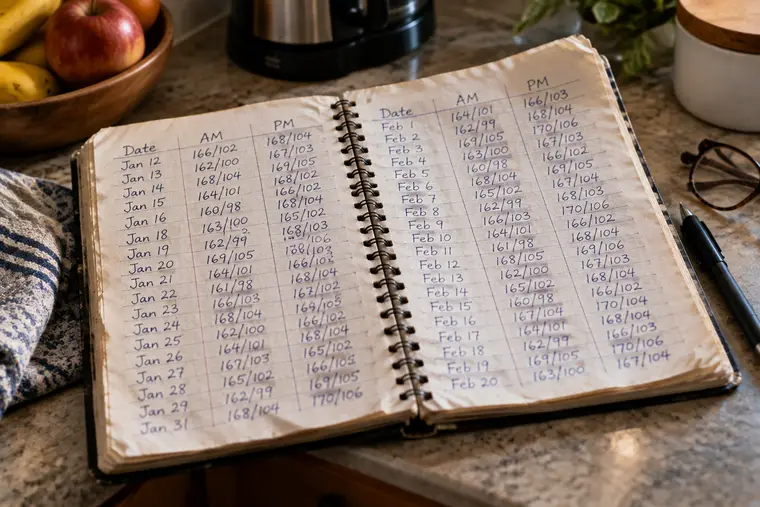
I did every single thing they asked. I still ended up on the floor on my granddaughter’s birthday.
And the first question in that room was whether I had tried hard enough.
The Woman in the Next Bed
The next day they moved me to a step-down unit. The woman in the bed beside mine was named Ruth. She was 68. She’d had a stroke five weeks earlier.
Ruth couldn’t lift a spoon. At lunch her husband fed her, one small bite at a time, and wiped her chin between bites. He did it so gently, like he’d been doing it his whole life.
Ruth was awake for every second of it. I could see it in her eyes.
That night I lay there listening to my monitor beep, and I understood something nobody had ever said to me out loud:
Dying wasn’t the thing to be afraid of. Surviving was.
Surviving, and needing someone to feed you. To lift you out of a chair. To help you in the bathroom.
I have a husband who would do all of that for me without a word. I did not want him to have to.
The Man in the Cafeteria
Two days later Rich came back from the hospital cafeteria and sat on the edge of my bed with a strange look on his face.
He’d been in line behind an old man. Easily 80. Two eggs, four strips of bacon, fried potatoes. Rich watched him pick up the salt shaker and cover the whole plate. Twice.
The man’s daughter said something to him. He laughed and said:
“My doctor says my blood pressure is the only thing about me that still works right.”
Neither of us said anything for a long time.
I hadn’t tasted real salt in six years. And I was the one hooked up to a monitor.
One question got stuck in my head that afternoon, and it stayed there for four months:
Why not him? Why me?
If salt were the whole story, he should have been in that bed. Not me.
Doctors Have Gotten This Wrong Before
I’m a librarian. When something doesn’t make sense, I look it up. So that’s what I did — every night at the kitchen table, with a legal pad and a pot of decaf.
The first thing I found stopped me cold.
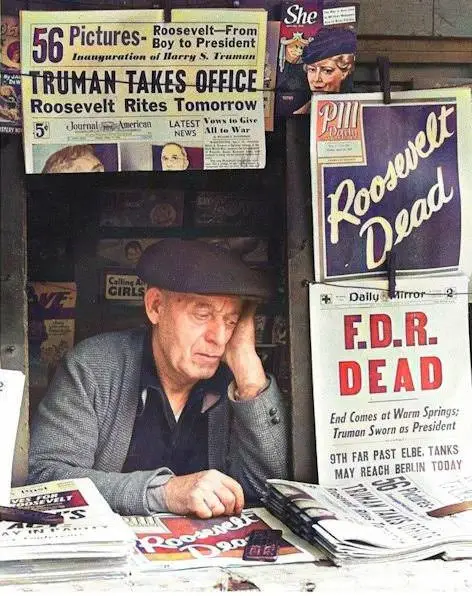
On April 12, 1945, President Franklin Roosevelt was sitting for a portrait when he said he had a terrible headache. He collapsed and died that afternoon. He was 63. The cause was bleeding in his brain.
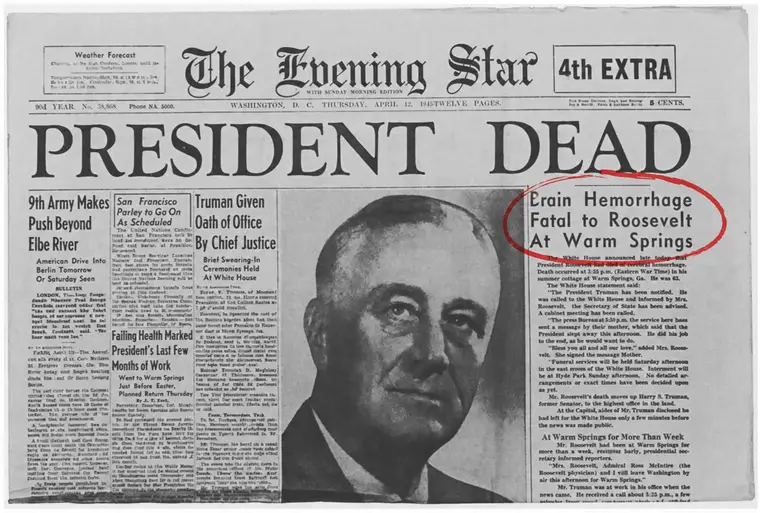
His blood pressure that day was recorded at around 300 over 190.
For years, nobody had really treated it. Not because his doctors were careless — he had the best doctors in the country. Because back then, much of medicine believed high blood pressure was the body’s way of pushing blood where it needed to go. Bringing it down was seen as risky.
Real blood pressure medicine didn’t arrive until the late 1950s.
Smart, caring doctors looked straight at high blood pressure and saw the wrong thing. Not because they were foolish. Because the missing piece hadn’t been found yet.
So I started asking a different question: what piece is still missing today?
What Researchers Found Inside the Arteries
In September 2024, the Journal of the American College of Cardiology published a study I must have read ten times.
Researchers followed 6,418 men and women, ages 45 to 84, for ten years. None of them had heart disease when it started.
At the beginning, they measured the metals each person carried in their body. One of them was cadmium.
Then they scanned their arteries for calcium buildup — the hard, chalky layer that makes an artery stiff.
The people with the most cadmium had 51% more of that hard buildup at the start. And over the ten years, their buildup ran 75% higher than in the people with the least.
Not salt. Not willpower. A metal — and the more of it people carried, the harder their arteries got.
And it wasn’t the first warning.
A year earlier, in 2023, the American Heart Association published a scientific statement on metals like lead and cadmium — the kind that get into us through water, food and air.
- Low-level exposure to metals like lead and cadmium is extremely common.
- Once they get in, they can stay in the body for decades.
- People with higher levels had a 15% to 85% higher risk of heart disease and stroke.
- These metals have been linked to plaque in the carotid artery — the one that feeds the brain.
Lamas GA et al., Journal of the American Heart Association, 2023. Full references at the end of this page.
I sat at that table and thought about nine years of notebooks.
Nine years of numbers. And not one person had ever asked what was actually inside my arteries.
Rich Drew It on My Legal Pad
Rich ran the maintenance department at a paper mill for 30 years. He doesn’t read medical journals. He fixes things. So when I tried to explain all this, he took my legal pad and drew a garden hose.
“A new hose is soft,” he said. “Squeeze it and it gives. Water runs right through.”
Then he drew a thick crust along the inside of it.
“Now the opening’s narrower. And the wall won’t bend. What do you do to get the same water out the other end?”
“Turn up the faucet,” I said.
“That’s your blood pressure. Your heart is the faucet. The pressure didn’t go up because of the water. It went up because of what’s stuck inside the hose.”
The doctor in the video I’m going to show you has a name for that crust. He calls it arterial rust — because of the metal locked inside it.
Once I saw it that way, everything I had done for nine years looked different.
Why Nothing I Did Ever Touched It
My pills were doing real work. They tell the hose to relax and open a little wider. That’s real, and I’m grateful for it.
But relaxing a hose with a crust inside it doesn’t remove the crust. It’s turning down the faucet while the rust stays exactly where it is.
That’s why my doctor added a second pill when the first one stopped being enough. And why so many people end up on a third.
- Blood pressure pills — they relax the hose
- Cutting out salt — it changes the water
- Walking every morning
- Losing weight
All good habits. I still keep them. But none of them were ever aimed at what’s stuck to the wall.
The Video Carol Sent Me
Four months after the birthday, my friend Carol from church sent me a link. Her husband had been passed it by someone at his cardiac rehab.
She wrote: “Diane. Watch this before you say anything.”
It was a presentation by a vascular doctor. It isn’t short, and he doesn’t sugarcoat anything. I almost closed it twice.
I’m so glad I didn’t.
Because in the very first minute, he said out loud the thing I had figured out lying next to Ruth: the real danger of a heart attack isn’t dying from one. It’s surviving one.
And then he answered the question that had followed me for four months — why the man with the bacon was fine, and I wasn’t.
I won’t try to explain all of it here. He does it far better than I could, and you need to see what he shows. But three things stayed with me.
1. The metal your arteries pull in on purpose
He explains why the walls of your arteries grab a metal like cadmium by mistake — they confuse it with a mineral they need to repair themselves. He calls it a Trojan horse. Once you understand that, you’ll understand why cutting salt was never going to reach it.
2. The island

There’s a mountain region on a Mediterranean island where an unusual number of people live past 100. They eat cured sausage, aged cheese and real salt, and drink red wine — into their 90s.
Everything I had been forbidden to eat. Item by item.
He went looking for what’s in their kitchens that isn’t in ours.
3. What he found
Two ordinary things. Odds are both are in your kitchen right now.
They work as a team, in a specific order: one helps loosen the metal and carry it out, the other helps the artery wall relax and flex again. And there’s one detail about how they’re prepared that changes everything — a detail that ruins most of what you’d find on a store shelf.
When he said what they were, I laughed out loud. I’ve had both in my pantry for 40 years.
▶ Watch the video Carol sent me
What Happened Next
I started the following Monday, with the morning routine he lays out near the end of the video.
The heavy feeling at the back of my neck — the one I had blamed on my pillow for years — wasn’t there when I woke up.
Rich grilled a steak and seasoned it with real salt. My first in six years. An hour later I checked my number with my heart pounding. Then I went to the drawer, took out my notebooks, and started flipping backward through the pages.
The morning headaches faded. I stopped checking three times in a row. I stopped being afraid of dinner.
I took my notebook to my cardiologist. He flipped back through the pages, comparing the old readings to the new ones. Then he looked up and said:
“Whatever you’re doing, keep doing it. And keep taking everything we have you on.”
So I do. Both.
And last month, at Ellie’s eighth birthday, I carried the cake out myself.
Before You Press Play
- Why so many people who do everything right still watch their number creep up — and their dose climb year after year
- The “Trojan horse” metal hiding in everyday water and food, and why your arteries pull it in by mistake
- Why the doctor worries less about his patients dying — and more about them surviving
- The Mediterranean island where people in their 90s eat cured meat, cheese and salt, and what’s in their kitchens that isn’t in yours
- The two ordinary ingredients, the order they work in, and the one preparation detail that ruins most store versions
- The short morning routine I followed — it takes less than a minute
- Give it your full attention. It isn’t a short clip. Sit down with a coffee — or better, with your husband or wife. Rich and I watched it twice.
- Watch to the end. The part that matters most — how to actually do it — comes near the end.
- The doctor is blunt about prescription drugs. Hear him out, but don’t stop or change any medication on your own. I didn’t. Bring what you learn to your own doctor.
P.S. I think about Ruth a lot. About her husband, and that spoon.
If you take one thing from my story, let it be this: doing everything right is not the same as reaching the right thing. I did everything right for nine years, and none of it was aimed at what was building up inside me.
Watch the video. Then talk to your doctor. Watch it here →
- McGraw KE, et al. Urinary Metal Levels and Coronary Artery Calcification: Longitudinal Evidence in the Multi-Ethnic Study of Atherosclerosis (MESA). J Am Coll Cardiol. 2024. acc.org
- Lamas GA, et al. Contaminant Metals as Cardiovascular Risk Factors: A Scientific Statement From the American Heart Association. J Am Heart Assoc. 2023;12:e029852. ahajournals.org
- Messerli FH. This Day 50 Years Ago. N Engl J Med. 1995;332:1038–1039.
These studies did not test any product, and their authors do not endorse any product.
Disclosure: This is an advertisement, not a news article or an independent review. Diane, Rich, Ellie, Ruth, Carol and the other people in this story are fictional characters. The story is a dramatization created for advertising purposes. Individual experiences vary.
The video on the next page is produced by the product’s manufacturer, not by this site. The owner of this site may receive compensation for purchases made after visiting this page.
Statements about dietary supplements have not been evaluated by the Food and Drug Administration. Dietary supplements are not intended to diagnose, treat, cure or prevent any disease, and they are not a substitute for prescribed medication. Never stop, reduce or change any medication without talking to your doctor. If you have chest pain, a sudden severe headache, weakness on one side of the body or trouble speaking, call emergency services right away.